


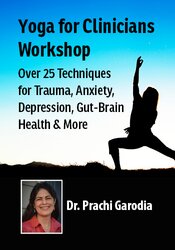
2-Day Yoga for Clinicians Workshop
Over 25 Techniques for Trauma, Anxiety, Depression, Gut-Brain Health & More
- Speaker:
- Dr. Prachi Garodia
- Duration:
- Two Full Days
- Language:
- Presented in EN, subtitles in EN and FR
- Product Code:
- LWC150869
- Brochure Code:
- PWZ96088
- Media Type:
- Live Webinar

Description
- Practical, personalized, integrative yoga-based nervous system regulation interventions you can use the very next day
Clients are burning out. Clinicians are burning out – because traditional approaches haven’t evolved to meet the moment.
Chronic stress, complex trauma, and constantly stimulating environments don’t let the body and mind quiet down.
Research keeps pointing to yoga-based practices as some of the most effective ways to regulate the nervous system.
Your clients need more … and you deserve the best tools that match the complexities of what you treat.
Therapeutic yoga offers the missing link.
Now, in this 2-Day Yoga for Clinicians training, you can learn how to bring these empirically supported tools directly into your clinical work – safely, skillfully, and in a way that fits seamlessly with your current approaches.
Join Dr. Prachi Garodia a quintuple board-certified physician in internal and lifestyle medicine among other expertise areas, who’s dedicated her life and work to trauma-informed mind-body healing through yoga, Ayurvedic medicine, and more. Dr. Garodia will give you step-by-step instruction for how to use therapeutic yoga interventions in session. Walk away able to:
- Quickly recognize patterns of imbalance, choose the right breath or movement
- Support mood and emotional regulation with daily rhythm strategies
- Enhance emotional resilience with foundational nutrition principles
- Understand the neuroscience behind WHY yoga, polyvagal and somatic tools work
- Calm the stress response to help clients go deeper into trauma and emotion processing
You’ll even learn strategies to optimize gut-brain health, reduce inflammation, and more with simple nutrition tools.
Whether you come to this training as a beginner or a clinician that loves yoga, you’ll leave with new healing strategies for clients and keys to prevent burnout in yourself.
Register now to integrate yoga into your sessions with ease!
Credit
Speaker

Dr. Prachi Garodia Related seminars and products
The Healing MD
Dr. Prachi Garodia, is a quintuple board-certified physician with training in internal medicine, lifestyle medicine, functional medicine, and Integrative Medicine. She is also nationally certified as a health & wellness coach. With over two decades of clinical experience, she combines conventional medicine with a variety of evidence-based mind-body practices to address the root causes of mental and physical health issues.
Dr. Garodia has trained in yoga, Ayurvedic medicine, mindfulness, meditation, Tai Chi/Qigong, Clinical Hypnosis, Guided Imagery, biofeedback, EMDR, Brainspotting, acupuncture, stress physiology, nutrition, and trauma-informed care. She has led multiple roles in integrative health within large healthcare systems. She now serves as clinical director of The Healing MD, where she offers advanced integrative care for trauma, mood disorders, chronic stress, burnout, and complex illnesses.
She loves teaching and leading experiential workshops, showing clinicians how to incorporate yoga-based nervous system regulation, trauma-informed somatic practices, functional nutrition, and Ayurvedic psychology into evidence-based clinical models. Her teaching style is approachable, practical, enjoyable, experiential, and rooted in both scientific and ancient healing knowledge.
Dr. Garodia’s work connects modern neurobiology with ancient wellbeing, whole-health systems, helping clinicians develop integrative approaches focusing on root cause, which significantly improves patient outcomes and satisfaction.
Speaker Disclosures:
Financial: Dr. Prachi Garodia has an employment relationship with The Healing MD, LLC. She receives a speaking honorarium from PESI, Inc. She has no relevant financial relationships with ineligible organizations.
Non-financial: Dr. Prachi Garodia has no relevant non-financial relationships.
Additional Info
Program Information
Access Period for Live WebcastYou will have access for 90 days after the program for review. For live CE credit, you must watch the live webcast in its entirety at its scheduled time and complete the CE quiz and evaluation within one week. Please note that this requirement may vary by credit type. Please see detailed credit information for specific requirements for each credit type.
Webcast Schedule
Please note: There will be a 70-minute lunch and two 15-minute breaks; one in the morning and one in the afternoon. Lunch and break times will be announced by the speaker and at their discretion. A more detailed schedule is available upon request.
Questions?
Visit our FAQ page at https://www.pesicanada.ca/faq or contact us at https://www.pesicanada.ca/contact-us.
Objectives
- Define the neurobiological and psychophysiological mechanisms through which yoga-based practices influence autonomic regulation, stress physiology, and emotional regulation.
- Identify key elements of yogic psychology—including the gunas, koshas, and mind-body regulation principles—and their relevance to mental health conditions.
- Examine autonomic dysregulation patterns (including hyperarousal, hypoarousal, dissociation) in clients with trauma, anxiety, depression, and chronic stress.
- Identify imbalance states contributing to emotional dysregulation based on Vedic mind-body patterns (Gunas).
- Utilize at least five evidence-informed breath, movement, and sensory regulation practices derived from yoga that can be safely used in clinical settings.
- Match specific yoga-based interventions to clinical presentations such as trauma hyperarousal, anxiety, depressive withdrawal, and emotional dysregulation.
- Integrate yoga-based somatic and lifestyle strategies—including breathwork, movement, meditation, and daily rhythm regulation—into mental health treatment planning.
- Develop a trauma-sensitive, 8-limb, yoga-informed protocol tailored to an individual client’s presentation.
- Examine ethical considerations, scope-of-practice issues, and contraindications when applying yoga practices in clinical care.
- Choose tools from lifestyle medicine including circadian rhythm and nutrition strategies for mood regulation.
- Examine safety considerations, risks, limitations and research regarding yoga in therapy.
- Utilize breathwork, movement, and polyvagal-informed interventions.
Outline
The Mental Health Crisis and the Need for Somatic Tools
- Current trends in anxiety, trauma, depression, and chronic stress
- Limits of purely cognitive approaches
- Overview of mind-body approaches in mental healthcare
- Where yoga fits in the integrative mental health model
- Audience poll & discussion: Somatic tools, clinical challenges in emotional regulation
Foundations of Yoga for Mental Health
- The Eight Limbs of Yoga (Ashtanga Yoga)
- Yoga as a system of nervous system regulation
- Distinction between: fitness yoga, therapeutic yoga, yoga therapy
- Clinical translation: Which limbs are most applicable in mental health settings
- How clinicians can ethically use yoga concepts
Neuroscience of Yoga, Polyvagal, and Mental Health
- Modern science behind yogic practices
- Stress physiology and the HPA axis
- Autonomic nervous system and emotional regulation
- Polyvagal theory and safety signaling
- To-down vs bottom-up regulation
- Neurotransmitter changes associated with yoga
- Evidence base for yoga in: PTSD, anxiety disorders, depression, chronic stress, and more
Yogic terminology and Psychology for Clinicians: Understand the mind using yogic frameworks
- Review the fundamental principles and terminology of yoga
- Pancha Koshas (five layers of human experience)
- The gunas (mental attributes): Sattva, Rajas, Tamas
- Clinical correlations with: anxiety, agitation, emotional dysregulation, depression, burnout
- Self-reflection exercise using Guna patterns
Breathwork for Emotional Regulation: Pranayama in Clinical Settings
- Breathing protocols: coherent breathing/HRV support; various specific techniques of breathwork for distinctive conditions
- Mechanisms: vagal activation, HRV improvement, CO2 regulation, emotional regulation
- 5 Practices clinicians can teach clients
Somatic Yoga Practices for Trauma, Anxiety & Depression, and more
- Polyvagal-informed movement & interventions
- Somatic grounding, interoception, and sensory-based regulation
- Clinical yoga micro-practices for trauma, anxiety, and depression
- Match yoga interventions to symptom and whole person profiles
- Case example: Anxiety + hyperarousal
- Limitations & risks: trauma triggers, dissociation, pacing concerns
Trauma-Sensitive Yoga Techniques
- Safety considerations: recognizing trauma responses, dissociation and shutdown, titration and pacing, avoid triggering cues, language, and consent
- Contraindications and red flags
- Case example: Trauma with hyperarousal
Yogic Lifestyle Medicine Tools
- Application of Yamas and Niyamas in daily life
- Yogic daily routine and circadian rhythm strategies for mood stability
- Yogic nutritional recommendations for improving mental health
- Clinical integration with psychotherapy
- Clinical application: How lifestyle patterns influence emotional regulation
- Limitations & risks: cultural sensitivity, limitations, and contraindications
Integrative Clinical Application & Treatment Planning
- Design individualized yogic protocols for trauma, anxiety, depression, and more
- Tools clients can practice at home
- Clinician self-care & sustainability: Use yoga tools personally to reduce burnout
- Ethical and scope-of-practice considerations
- Final clinical integration exercise
- Closing session: Q and A
Target Audience
- Counselors
- Social Workers
- Psychologist
- Psychotherapists
- Therapists
- Marriage & Family Therapists
- Addiction Counselors
- Case Managers
- Physicians
- Nurses
- Yoga Teachers and Integrative Health Professionals
- Anyone working with trauma, anxiety, depression, or stress-related disorders
- Other Mental Health Professionals
Reviews
Satisfaction Guarantee
Your satisfaction is our goal and our guarantee. Concerns should be addressed to info@pesicanada.com.
Please wait ...