- Home
- Blogs
- Understanding the 6 Types of Boundaries

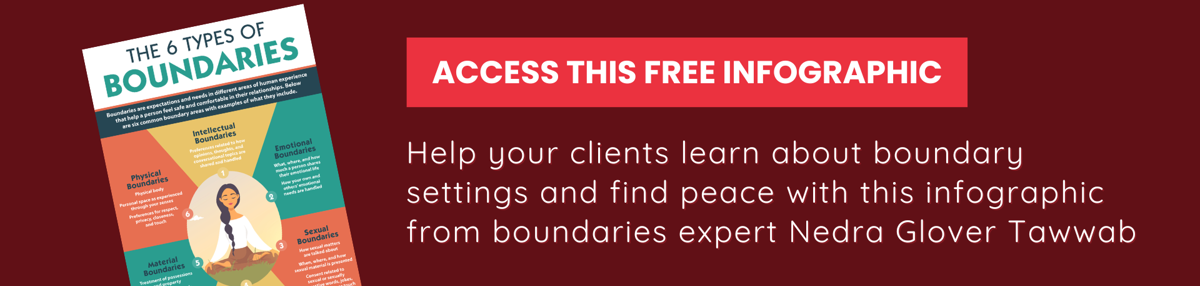
The key to healthier relationships is teaching clients how to establish boundaries. Boundaries are expectations and needs in different areas of human experience that help a person feel safe and comfortable in their relationships. Bestselling author and boundaries expert Nedra Glover Tawwab classifies boundaries into 6 distinct categories. They are:
- Intellectual boundaries: Preferences related to how opinions, thoughts, and conversational topics are shared and addressed.
- Emotional boundaries: What, where, and how much a person shares their emotional life and how your own and others’ emotional needs are handled.
- Sexual boundaries: How sexual matters are talked about, when, where, and how sexual material is presented, and consent related to sexual or sexually suggestive words, jokes, images, gestures, or touch.
- Time boundaries: How you relate to your own and others’ time and how time-related needs and preferences are treated.
- Material boundaries: Treatment of possessions and property, preferences and needs regarding possessions and property and how possessions and property are shared.
- Physical boundaries: Physical body, personal space as experienced through your senses and preferences for respect, privacy, closeness, and touch.
Use this free infographic to educate clients on the different types of boundaries they can set, what violations can look like, and how they can protect their peace.
Breaking the Cycle of Unhealthy Family Relationships: Top Tools for Better Boundaries
Learn top tools for better boundaries directly from relationship expert and acclaimed clinician and author, Nedra Glover Tawwab, LCSW.
She’ll give you practical, easy-to-implement interventions that you can use right away to help your clients set better boundaries and transform their interactions with difficulty family members.
Navigating Unhealthy Family Dynamics, Emotionally Immature Parents, and Estrangements
Help clients break the cycle of unhealthy family relationships to create a new legacy of self-respect and healthy boundaries.
You May Also Be Interested In These Related Blog Posts
Coping with Negative Thoughts After the Death of a Loved One
In the aftermath of losing a loved one, clients’ thoughts may turn negative—or even downright catastrophic. Grief expert Claire Bidwell Smith offers activities to work with this extremely tender population.
Making the Most Informed Choice: The SODAS Problem-Solving Model
Help young clients make healthy choices with this simple problem-solving paradigm. David Pratt presents a step-by-step way to identify options, consider advantages and disadvantages, and select a course of action.
6 Step IFS Therapy Process to Jumpstart Healing
Use this simple exercise from the evidence-based Internal Family Systems therapy model to help your clients understand and work with their internal parts so they can begin the deep healing process that traumatic wounds require.
6 Practices for Grieving Clients Suffering from Loss
Grief is a deeply personal and transformative journey—one that cannot be rushed, fixed, or fully understood by anyone but the person experiencing it. David Kessler shares valuable insights to help clients navigate their unique experiences of loss, deepen their understanding of grief, and gently guide them toward healing and renewal.
Coping with Negative Thoughts After the Death of a Loved One
In the aftermath of losing a loved one, clients’ thoughts may turn negative—or even downright catastrophic. Grief expert Claire Bidwell Smith offers activities to work with this extremely tender population.
Making the Most Informed Choice: The SODAS Problem-Solving Model
Help young clients make healthy choices with this simple problem-solving paradigm. David Pratt presents a step-by-step way to identify options, consider advantages and disadvantages, and select a course of action.
6 Step IFS Therapy Process to Jumpstart Healing
Use this simple exercise from the evidence-based Internal Family Systems therapy model to help your clients understand and work with their internal parts so they can begin the deep healing process that traumatic wounds require.
6 Practices for Grieving Clients Suffering from Loss
Grief is a deeply personal and transformative journey—one that cannot be rushed, fixed, or fully understood by anyone but the person experiencing it. David Kessler shares valuable insights to help clients navigate their unique experiences of loss, deepen their understanding of grief, and gently guide them toward healing and renewal.