


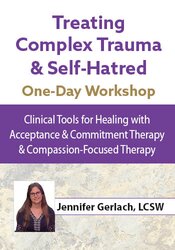
Treating Complex Trauma & Self-Hatred
Clinical Tools for Healing with Acceptance & Commitment Therapy & Compassion-Focused Therapy
- Speaker:
- Jennifer Gerlach, LCSW
- Duration:
- 5 Hours 51 Minutes
- Language:
- Presented in EN, subtitles in EN and FR, handouts in EN and FR
- Format:
- Audio and Video
- Copyright:
-
Feb 12, 2026
- Product Code:
- POS150554
- Media Type:
- Digital Seminar

Description
- ACT and Compassion-Focused strategies to quiet the inner critic
- Step-by-step strategies to shift self-hatred into self-acceptance
- Help clients rewire their relationship with themselves for life
When a client looks at you and says “I hate myself,” it’s more than heartbreaking – it’s clinically complex.
Self-hatred isn’t just low self-esteem. It’s tangled with trauma, shame, anxiety, and depression.
Clients who loathe themselves, who can’t accept care, who reject every attempt at healing.
Without the right clinical tools, it’s easy to feel struck – like you’re circling the problem without ever helping them break free.
That’s where this training comes in.
In this training Jennifer Gerlach, expert in Acceptance and Commitment Therapy, Compassion-Focused Therapy and trauma-informed healing, will guide you through evidence-based, effective techniques to target self-hatred and treat trauma – even in the face of complexities like anxiety, shame, and more.
You’ll learn a powerful way to move beyond resistance and reach the deep-rooted threat-based responses that keep clients stuck in cycles of self-criticism. In this training, you’ll discover:
- Practical, ready-to-use ACT and Compassion-Focused techniques to quiet the inner critic
- Step-by-step strategies to shift self-hatred into self-acceptance
- How to help clients rewire their relationship with themselves – so healing becomes possible
- Interventions that empower clients to build resilience, reduce anxiety and depression, and embrace a sense of peace
There’s no greater reward than seeing clients finally extend compassion to themselves – transforming pain into strength and hopelessness into healing.
Purchase now and walk away with the tools that don’t just heal trauma … they replace self-hatred with fulfillment and a life worth living.
Credit
Speaker

Jennifer Gerlach, LCSW Related seminars and products
Jennifer Gerlach, LCSW, is a psychotherapist in private practice in southern Illinois specializing in the crossroads of mental health, trauma and neurodiversity utilizing interventions informed by compassion-focused therapy, acceptance commitment therapy, EMDR and other traditions. Jennifer is the author of The Psychosis and Mental Health Recovery Workbook: Tools for Young Adults from ACT, DBT and Recovery-Oriented CBT and writes a blog for Psychology Today entitled ‘Beyond Mental Health: Defying Stereotypes and False Limitations.’
Jennifer has provided training to hundreds of clinicians nationwide on topics related to neurodiversity, mental health and healing trauma. She offers a unique perspective infused with her lived experience as an individual who has walked her own journey toward mental health and self-acceptance as an autistic person herself.
Speaker Disclosures:
Financial: Jennifer Gerlach maintains a private practice and receives royalties as a published author. She receives a speaking honorarium from PESI, Inc. She has no relevant financial relationships with ineligible organizations.
Non-financial: Jennifer Gerlach has no relevant non-financial relationships.
Additional Info
Program Information
Questions?Visit our FAQ page at https://www.pesicanada.ca/faq or contact us at https://www.pesicanada.ca/contact-us.
Access for Self-Study (Non-Interactive)
Access never expires for this product.
For a more detailed outline that includes times or durations of time, if needed, please contact cepesi@pesi.com.
Objectives
- Identify core aspects of compassion and self-compassion.
- Utilize mindfulness strategies to assist clients in building self-compassion.
- Utilize CFT strategies to explore with clients their experiences of threat, reward, and social-affiliative systems.
- Integrate acceptance and commitment therapy approaches to empower clients.
- Identify ways that trauma, mood disorders, and neurodivergence can affect sense of self.
- Utilize ACT strategies to break cycles of self-destructive behaviors.
Outline
Mapping Out the Relationship Between Self-Hatred & Trauma
- Understand core elements of relationship with self
- Impact of trauma on sense of self and self-worth
- Notice subtle Indicators of shame
- Explore the limits of traditional approaches
- Research, risks, limitations, ethical considerations
- Cultural considerations
- Overview of 4 self-compassion approaches to therapy
Self-Compassion Practices for Shame, Interpersonal Struggles & More
- Explroe Dr. Neff’s three components of self-compassion
- Mindfulness as “contact with the present moment”
- Exercise: Grounding practice for working through shame storms
- Common humanity as a relational intervention
- Exercise: Loving Kindness Meditation to Broaden Compassion to Include Self and Others
- Enhance self-kindness and inner talk
- Exercise: Compassionate Friend Practice for a More Accepting Relationship with Self
- Other practical strategies to use with any client
Compassion-Focused Therapy (CFT) Skills Training, Visualization, Attention Practices & More
- Know the three systems: Threat, Drive, Social-Affiliative
- Exploration of the threat system and neurobiology
- What to do when the threat system is in overdrive
- Compassionate interventions for a healthy drive system
- How to work with motivation, perfectionism, and controlling drives
- Treat procrastination, overwhelm, or a shutdown drive system
- When the threat system overpowers the drive system
- Skills training to ignite compassion and the social-affiliative system
Acceptance Commitment Therapy (ACT) Interventions for Self-Criticism, Shame, Self-Forgiveness & More
- Review of ACT’s 6 dimensions, psychological flexibility, and more
- Values-center
- Clarify values related to self
- Know the common client hang-ups and work arounds
- Defusion
- Holding painful stories lightly and working with:
- The “I Don’t Deserve Healing” Story
- The “I Am Not Good Enough” Story
- The “Self-Criticism is Responsible for my Success” Story
- The “I Hate Myself” Story
- Experiential Acceptance
- Address shame and other emotions
- Encourage self-acceptance
- Explore self-forgiveness
- Self-as-Context
- Rewrite the narrative
- Let go of the narrative
- Contact with the present moment
- Engage mindfulness and self-compassion
- Create Committed Action
- Guide compassion behavior
- Let go of self-destruction
Working with Special Populations
- Complex Trauma
- Neurodivergent clients
- Anxiety
- Mood Disorders
- Psychosis
Target Audience
- Counsellors
- Social Workers
- Psychiatrists
- Psychologists
- Case Managers
- Addiction Counsellors
- Therapists
- Marriage & Family Therapists
- Psych Nurses
- Other Mental Health Professionals
Reviews
Satisfaction Guarantee
Your satisfaction is our goal and our guarantee. Concerns should be addressed to info@pesicanada.com.
Please wait ...