


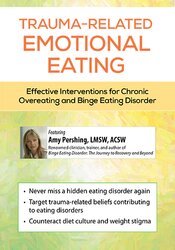
Trauma-Related Emotional Eating: Effective Interventions for Chronic Overeating and Binge Eating Disorder
- Speaker:
- Amy Pershing, LMSW, ACSW, CCTP-II
- Duration:
- 6 Hours 23 Minutes
- Language:
- Presented in EN, subtitles in EN and FR, handouts in EN and FR
- Copyright:
-
Oct 10, 2025
- Product Code:
- POS058970
- Media Type:
- Digital Seminar - Also available: Live Webinar

Description
Trauma creates fertile ground for issues with food.
When does emotional eating become disordered eating? And when does disordered eating become an eating disorder?
Most clinicians are not aware of the overlap between trauma, emotional eating, and eating disorders, missing key interventions that relieve clients’ suffering.
Your clients may be struggling at mealtimes – and if you aren’t asking about their relationship with food, you may unintentionally be reinforcing their shame.
Really – given the high rates of co-occurrence – if you’re doing trauma work, you likely already have clients with disordered eating, including Binge Eating Disorder (BED), the most common and most underdiagnosed eating disorder.
Not an eating disorders specialist? You can still treat BED! Amy Pershing, LMSW, ACSW, expert BED psychotherapist, will share with you a comprehensive, evidence-based toolkit of successful interventions that will:
- Transform your client’s relationship with food, weight, and body image
- Approach trauma and binge eating disorder from an IFS therapy-informed framework, somatic interventions, and more
- Integrate the crucial strategies of attuned eating and movement
- Root your practice in the tenets of weight-neutral recovery
Don’t let trauma continue to wreak havoc on your clients’ experience of eating. Purchase now to help your traumatized clients forge a peaceful relationship with food.
Credit
Speaker

Amy Pershing, LMSW, ACSW, CCTP-II Related seminars and products
Center for Eating Disorders
Amy Pershing, LMSW, ACSW, CCTP-II, is the Founder of Bodywise. She is the President of the Board of the Center for Eating Disorders in Ann Arbor, Michigan, and co-founder of Pershing Consulting, LLC, which offers training to clinicians treating BED and trauma worldwide. She is also the Co-Founder of the Eating Disorders Education Institute (EDEI), a national training program for eating disorder professionals.
Amy is an internationally known leader in the development of treatment paradigms for BED, and one of the first clinicians to specialize in BED treatment. Based on 35 years of clinical experience, Amy has pioneered an approach to BED recovery that is strengths-based and trauma informed, uniquely designed to heal the deeper issues that drive binge behaviors. Her approach integrates a non-diet body empowerment philosophy, helping clients create lasting change with food and body image. Amy also specializes in working with neurodivergence and BED.
Amy lectures and teaches internationally on the treatment of BED for professional and lay communities; she has been featured on radio, podcast, and television programs around the world, speaking about BED treatment and recovery, relapse prevention, weight stigma, and a non-diet approach for eating and movement. She is the Past Chair of the Binge Eating Disorder Association (BEDA), and winner of BEDA’s Pioneer in Clinical Advocacy award. She is the author of the book Binge Eating Disorder: The Journey to Recovery and Beyond and The Emotional Eating, Chronic Dieting, Binge Eating & Body Image Workbook, with co-authors Judith Matz and Christy Harrison.
Speaker Disclosures:
Financial: Amy Pershing is the founding director of Bodywise and has an employment relationship with The Center for Eating Disorders. She receives royalties as a published author. Amy Pershing receives a speaking honorarium, recording, and book royalties from Psychotherapy Networker and PESI, Inc. She has no relevant financial relationships with ineligible organizations.
Non-financial: Amy Pershing is a founding board member of the Eating Disorders Action Network and The Body Freedom Project. She is the membership chair for the Eating Disorders Professional League of Michigan.
Additional Info
Program Information
Access for Self-Study (Non-Interactive)Access never expires for this product. For a more detailed outline that includes times or durations of time, if needed, please contact cepesi@pesi.com.
Questions?
Visit our FAQ page at https://www.pesicanada.ca/faq or contact us at https://www.pesicanada.ca/contact-us.
Objectives
- Analyze the relationships between stress, trauma, diet culture, weight stigma, and emotional eating.
- Utilize trauma-informed assessment questions to gather information about clients’ food history and body image to inform the clinician’s choice of treatment interventions.
- Appraise the relationship between weight and health to help clients identify and challenge internalized weight stigma and body shame.
- Analyze the role of dissociation and identity fragmentation in BED.
- Employ IFS therapy-informed strategies to assist clients with building affect tolerance and developing self-compassion.
- Develop two strategies for navigating counter transference and clinician bias.
Outline
The Spectrum of Overeating: From Emotional Eating to Binge Eating Disorder (BED)- Toxic context of diet culture and weight stigma
- Key facts about the role of trauma and dissociation
- Why food addiction is a myth
- Common triggers to bingeing, including therapy and therapists
- Client voices – what a binge is really like
- 5 must-ask intake questions and how to gather food history information
- Understand clients’ eating behaviors
- Assess mental health comorbidities and co-occurring medical issues
- Connection between binge eating and body image
- Key tenets of weight-neutral recovery
- The truth about the relationship between weight and health
- Challenge cultural messages regarding weight stigma and fat phobia
- Integrate Health at Every Size (HAES) into your practice
- The body as wise ally: Using the body as the best source of information
- 5 steps of attuned eating
- Attuned movement versus exercise
- Why a do-no-harm, strengths-based approach is critical
- How threats to foundational safety create core beliefs supporting eating disorders
- Teach clients to know when the trauma narrative has been triggered
- Help clients step into “Self” with IFS therapy-informed recovery strategies
- Work directly with fragmented parts to stop the binge-diet cycle
- Best practice somatic interventions
- Reinvent body image to help clients feel at home in their bodies
- Help clients develop connections that build resilience and align with recovery
- Impact on treatment of the clinician’s relationship with food and body image
- Tips for modeling body acceptance, respect, and love in your practice
- Multicultural issues – gender, race/ethnicity, sexual orientation, socioeconomic status, and more
- Form collaborative relationships with other treating professionals
- Resources for weight-neutral medical/nutritional care
- Limitations of the research and potential risks
Target Audience
- Counsellors
- Social Workers
- Psychologists
- Marriage & Family Therapists
- Physicians
- Addiction Counsellors
- Case Managers
- Registered Dieticians & Dietetic Technicians
- Nurses
- Psychiatric Nurses
- Other Mental Health Professionals
Reviews
Satisfaction Guarantee
Your satisfaction is our goal and our guarantee. Concerns should be addressed to info@pesicanada.com.
Please wait ...