


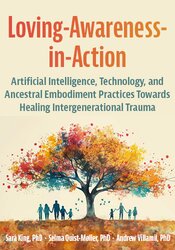
Loving-Awareness-in -Action
Artificial Intelligence, Technology, and Ancestral Embodiment Practices Towards Healing Intergenerational Trauma
- Speakers:
- Sara King | Selma Quist-Moller | Andrew Villamil, PhD
- Duration:
- 6 Hours 19 Minutes
- Language:
- Presented in EN, handouts in EN and FR
- Copyright:
-
May 02, 2024
- Product Code:
- POS059888
- Media Type:
- Digital Seminar

Description
With groundbreaking research, we now know trauma can be passed down from generation to generation, known as intergenerational trauma. In this presentation, you will explore what it means to be human in the context of the different types of technology. The context of the epidemic of mental health, including impact of intergenerational trauma, is explored. Mindfulness has multiple physiological and psychological benefits, including increasing empathy and healthy aging and ways to incorporate these strategies into clinical work for improved social/ emotional health are shared. Learn how to change generational trauma into generational wealth.
Credit
Speaker

Sara King Related seminars and products
Dr. Sará King is a neuroscientist, artist, political and learning scientist, education philosopher, social impact entrepreneur, public speaker, and certified yoga and mindfulness meditation instructor. She is currently a post-doctoral fellow in public health at the T. Denny Sanford Institute for Empathy and Compassion in Human Health and Social Justice at UCSD. She is also the co-director of Mobius, a home for the development of Liberatory Technology, and the founder of MindHeart Collective, a contemplative tech company that she founded to develop AI-integrated platforms, applications, and courses grounded in neuroscience, "The Science of Social Justice" framework and the "Systems Based Awareness Map" (SBAM) which she developed to explore our capacity to heal intergenerational trauma and promote the well-being of "collective nervous systems". In 2021, she was named "One-To-Watch" by Mindful Magazine, as well as she made the November cover of Yoga Journal Magazine as a "Game Changer" for her work bridging neuroscience, social justice and contemplative practices. In 2022, she was also named one of the "10 Most Powerful Women in Mindfulness" by Mindful Magazine.
Speaker Disclosures:
Financial: Dr. Sara King has employment relationships with The Mindsight Institute and Mindheart Collective. She receives a speaking honorarium and recording royalties from PESI, Inc. She has no relevant financial relationships with ineligible organizations.
Non-financial: Dr. Sara King is a core member of Google Vitality Lab.

Selma Quist-Moller Related seminars and products
Selma Quist-Møller is a psychologist educated from UC Berkeley, UCLA, and Copenhagen University, a researcher, writer, and mother studying post-traumatic growth from complex, collective, and intergenerational trauma. In her work, Selma bridges science and trauma-informed contemplative practices to help generate awareness and action cultivating individual, collective, and planetary well-being, health, justice, and growth. Selma is trained and mentored by Dr. Dan Siegel in the interdisciplinary approach of interpersonal neurobiology, and she was a 2020/2022 Garrison Institute Fellow, working with a diverse cohort of scholars, artists, and activists to blaze a new trail in the field of collective healing and growth, drawing upon and engaging with the science of interconnection, generative action, and contemplative wisdom.
Selma has shared her work in places like the Danish Parliament, UC Berkeley’s Greater Good Magazine, The International Conference in Mindfulness, PwC, and Wisdom 2.0’.
Speaker Disclosures:
Financial: Selma Quist-Moller has employment relationships with MindheartAI, The Trauma Clinic, UC Berkeley’s Greater Good Magazine and LetsReimagine.com. She receives royalties as a published author. Selma Quist-Moller receives compensation as a freelancer. She receives a speaking honorarium from PESI, Inc. She has no relevant financial relationships with ineligible organizations.
Non-financial: Selma Quist-Moller is an advisory board member of WellMiss.com.
Andrew Villamil, PhD Related seminars and products
Andrew Villamil is a Well-Being Scientist with an extensive academic and clinical background. Having completed his master’s degree in clinical psychology and specialized training for licensure in marriage and family therapy from Pepperdine University. He is now finishing his second master’s and PhD in Positive and Developmental Psychology at Claremont Graduate University.
For over 13 years, Andrew has worked in several roles at UCLA Health and the David Geffen School of Medicine at UCLA, working in operations for emergency services, international research, clinical programs, and interventions. His philosophy centers on the pivotal synergy between basic, translational and applied research to cultivate practical and real-world applications.
Speaker Disclosures:
Financial: Andrew Villamil has employment relationships with University of California and LeAD Labs. He receives a speaking honorarium from PESI, Inc. He has no relevant financial relationships with ineligible organizations.
Non-financial: Andrew Villamil is a fellow with the Garrison Institute Fellowship, the American Association for the Advancement of Science , the Association for Psychological Science, and the American Psychological. He supports research with MindHeart AI.
Additional Info
Program Information
Access for Self-Study (Non-Interactive)Access never expires for this product.
Questions?
Visit our FAQ page at https://www.pesicanada.ca/faq or contact us at https://www.pesicanada.ca/contact-us.
Objectives
- Facilitate embodied practices to tap into the rhythm of our ancestors.
- Develop an awareness of the components of a social and emotional learning program to use with clients to help manage stress.
- Define the levels of the systems-based awareness map and ways to apply this in clinical practice.
- Identify how to bring technology into intentional activities to increase happiness and well-being.
- Articulate how neurobiology is affected by social media use.
- Construct a phase system to change generational trauma into generational wealth.
- List the elements of compassion in client care for providers to implement in practice.
Outline
- Introduction
- Tapping into field of ancestral intelligence
- Embodied group practice
- Contemplative practice
- Research exploration of science of social justice
- Motivators to begin mindfulness
- Sources of student stress
- Social emotional learning programs
- Science of mindfulness
- Container for cultivation of contemplative leadership
- Garrison Institute Fellowship
- Development of theoretical framework of science of social justice
- 4-E model of cognition
- Science and embodiment-based redefinition
- Systems-Based Awareness Map
- Liberator technology: Technology supporting aliveness and flourishing
- Art and science of hope and justice
- Art and awareness as a catalyst for healing
- Well-being revisited through lens of science of social justice
- Subjective well-being
- Hedonic adaptation
- What determines happiness
- Human development and digital environments
- Integration
- Research
- Social learning theory
- Conceptualizing digital learning theory
- Reciprocal determinism
- AI Design and negative/ positive technology
- Connected neural network
- Unsupervised learning
- Social media and the brain
- Negative technology
- Moderation-path analysis
- Reshaping future with positive technology design
- Good technology
- Liberatory technology
- Engaging in the good
- Limitations and potentialities of mind in relation to awareness and technology
- Breaking ouroboros: Cracks from collective trauma and opportunities for post-traumatic growth and collective awakening
- Treating people who were part of a gang
- Philosophical approach
- Phases of development
- March toward wellness
- Experiential/ meditation activities
- Multicultural communities and neurofeedback
- Providing appropriate support for families
- Overcoming challenges
- Outcomes
- Case presentations
- Preventing clinician burnout
- Question and answer
- Ideas for future research
Target Audience
- Counsellors
- Marriage and Family Therapists
- Physicians
- Social Workers
- Other Mental Health Professionals
Reviews
Satisfaction Guarantee
Your satisfaction is our goal and our guarantee. Concerns should be addressed to info@pesicanada.com.
Please wait ...