


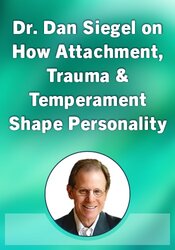
Dr. Dan Siegel on How Attachment, Trauma & Temperament Shape Personality
Applications from Interpersonal Neurobiology to Inspire Your Clinical Work
- Speaker:
- Daniel J. Siegel, MD
- Duration:
- 9 Hours
- Language:
- Presented in EN, subtitles in EN and FR, handouts in EN and FR
- Format:
- Audio and Video
- Copyright:
-
Apr 15, 2025
- Product Code:
- POS150105
- Media Type:
- Digital Seminar

Description
These days, if the modern human mind could have a personal translator, PR agent, and cheerleader, that person would be Dan Siegel! Dr. Siegel is founder and director of education at the Mindsight Institute and founding co-director of the Mindful Awareness Research Center at UCLA, where he was also a principal investigator of the center for Culture, Brain, and Development and clinical professor at the medical school. He is also the founding editor of the Norton professional series on Interpersonal Neurobiology which has over one hundred textbooks in its transdisciplinary library.
Siegel’s bestselling books have found their way into the hands of millions of everyday people seeking advice on developing awareness, regulating emotions, and raising whole-brain children. Having worked as a therapist and educator for over 40 years, Dr. Siegel understands people and their patterns—on both a individual and relational level. More than any other psychiatrist alive today, he’s changed the way we live, communicate, parent, and think about who we are and who we can become.
In this immersive workshop, you’ll explore an interpersonal neurobiology approach to harnessing the insights of developmental neuroscience to illuminate how early temperament interweaves with attachment experiences in the cultivation of nine patterns of personality. This exciting new framework is called PDP: Patterns of Developmental Pathways and offers a deep dive into the ways temperament shapes the emergence of personality—our patterns of thinking, feeling and behaving across stages and settings of our lives.
Recent research has revealed an exciting new view of the ways we interact with the world, focus our attention, experience and express emotion, and think. In this workshop, we’ll explore the PDP framework and how it was originally inspired by a system known as the “Enneagram of Personality. ” Working with four other scientists, Dan spent twenty years applying the lens of interpersonal neurobiology that sheds light on the human quest for wholeness and meaning to tens of thousands of oral narratives they were able to explore. For a clinician, this new PDP perspective offers a way to both understand yourself, and your clients, in empowering and illuminating ways. By discerning the innate temperament we’re born with and the learned mechanisms of adaptation, you can empower clients to transform personality patterns from the prisons of chaos and rigidity they may have become into playgrounds of connection and possibility.
It is fascinating, and often frustrating and surprising, that most of us were not trained in models of personality, only in views on personality disorder. But temperament we are born with, the innate propensities of the nervous system that are not learned but inborn, do not disappear after our childhood years. Instead, we develop adaptive strategies to handle these neural proclivities; and it is these strategies of emotion, thought, and behavior that shape our personality. This new PDP framework helps us understand both the popular view of the Enneagram system, but also is consistent with a deep analysis of rigorous academic research on personality development. In this workshop you will become deeply conversant with the details of the PDP model and how to apply it in your daily life and clinical work.
Have your mind blown by our field’s beloved mind expert! This cutting-edge training offers approaches that can be effectively integrated into the clinical assessment and treatment plan of our client population.
Credit
Speaker

Daniel J. Siegel, MD Related seminars and products
Mind Your Brain, Inc.
Dr. Dan Siegel is the founder and director of education of the Mindsight Institute and founding co-director of the Mindful Awareness Research Center at UCLA, where he was also co-principal investigator of the Center for Culture, Brain and Development and clinical professor of psychiatry at The School of Medicine.
An award-winning educator, Dan is the author of five New York Times bestsellers and over fifteen other books which have been translated into over forty languages. As the founding editor of the Norton Professional Series on Interpersonal Neurobiology (“IPNB”), Dan has overseen the publication of over one hundred books in the transdisciplinary IPNB frame which focuses on the mind and mental health.
A graduate of Harvard Medical School, Dan completed his postgraduate training at UCLA specializing in pediatrics, and adult, adolescent, and child psychiatry. He was trained in attachment research and narrative analysis through a National Institute of Mental Health research training fellowship focusing on how relationships shape our autobiographical ways of making sense of our lives and influence our development across the lifespan.
Speaker Disclosures
Financial: Dr. Dan Siegel serves as the Medical Director at the Lifespan Learning Institute and is the Co-Founder and Director of Education at the Mindsight Institute. He is also the founding editor of the Norton Series on Interpersonal Neurobiology. Dr. Siegel receives royalties as a published author and serves as a scientific advisor for the Inner Development Goals initiative and as an advisor for the Center for Child Well-Being. Additionally, he receives honoraria and recording royalties from Psychotherapy Networker and PESI, Inc. Dr. Siegel has no relevant financial relationships with ineligible organizations.
Non-financial: Dr. Dan Siegel is an honorary member of the Austrian Federal Association for Mindfulness. He also serves on the Board of the Garrison Institute and as an advisory board member for both Gloo and Convergence.


Additional Info
Program Information
Access for Self-Study (Non-Interactive)Access never expires for this product.
For a more detailed outline that includes times or durations of time, if needed, please contact cepesi@pesi.com.
Questions?
Visit our FAQ page at https://www.pesicanada.ca/faq or contact us at https://www.pesicanada.ca/contact-us.
Objectives
- Describe the interplay of temperament and attachment in the development of personality and human flourishing.
- Identify nine Patterns of Developmental Pathways (PDPs) that help illuminate distinct growth-edges for lifelong development.
- Explain how an individual’s insights into their own PDP and those of others can give powerful avenues for understanding life journeys and personal relationships illuminating the many ways we can be at risk of burnout and stress.
- Outline nine patterns of personality and how these emerge from early temperament and are intensified by non-secure attachment experience.
- Discuss how the neuroplasticity of the brain enables clinicians to support clients in reshaping maladaptive personality patterns through targeted interventions at PDP specific growth-edges.
- Apply the Patterns of Developmental Pathways (PDP) framework to identify client-specific strategies for fostering emotional regulation and resilience.
- Evaluate the influence of interpersonal neurobiology on therapeutic approaches to treating trauma-related constrictions in personality development.
- Integrate the understanding of early temperament and attachment stances into the development of personalized treatment plans for diverse populations.
- Demonstrate methods to facilitate client awareness of their own developmental patterns and utilize this insight for therapeutic breakthroughs.
- Explore strategies for maintaining clinician well-being by recognizing how PDPs and attachment patterns affect therapist-client dynamics and countertransference.
Outline
Why Focus on Personality in Psychotherapy
- Expand your learning beyond traditional “Personality Disorders”
- Explore personality patterns emerging from temperament
- Attachment and how it can lead to a low or high level of each personality pattern
- Personality patterns, research on temperament, attachment and the Enneagram system
The Patterns of Developmental Pathways (PDP) Model
- Summary of current research, risks, and treatment limitations
- Neurobiologically informed framework of personality
- Lifespan model of personality
- Importance of seeking a sense of “wholeness”
- How temperament shapes the adaptive strategies underlying personality
- Role of trauma and attachment relationships
Integrate Interpersonal Neurobiology Approach
- Integration of neuroscience into clinical practice to transform personality patterns
- Insights from interpersonal neurobiology to help clients cultivate a sense of well-being and connection
- Strategies to integrate the PDP framework into an interpersonal neurobiology model for effective treatment
Integrating the PDP Framework into Clinical Practice
- Outline the nine patterns of personality
- How these patterns emerge from early temperament and are intensified by nonsecure attachment experiences
- PDP to illuminate a client’s distinct growth-edges to move from low to high levels of functioning
- Help clients use their own PDP as a powerful tool to understand their risk for burnout and stress
Target Audience
- Counselors
- Social Workers
- Psychologists
- Addiction Counselors
- Marriage & Family Therapists
- Nurses
- Psychiatrists
- Physicians
- Other Mental Health Professionals
Reviews
Satisfaction Guarantee
Your satisfaction is our goal and our guarantee. Concerns should be addressed to info@pesicanada.com.
Please wait ...