


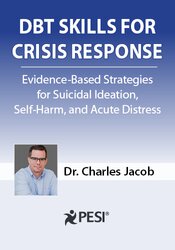
DBT Skills for Crisis Response
Evidence-Based Strategies for Suicidal Ideation, Self-Harm, and Acute Distress
- Speaker:
- Charles Jacob, PhD
- Duration:
- 4.25 Hours
- Language:
- Presented in EN, subtitles in EN and FR
- Product Code:
- LWC151076
- Brochure Code:
- PWZ96994
- Media Type:
- Live Webinar

Description
- Get a structured, practical framework for responding to suicidal ideation and self-harming behaviors.
- Strategies for guiding crisis conversations toward collaborative planning that promotes safety, connection, and hope.
- Leave with a toolbox of DBT strategies to support client safety, emotional regulation, and treatment engagement.
When a client shares suicidal thoughts or engages in self-directed violence, clinicians often face complex decisions regarding assessment, intervention, and risk management.
In this 4-hour webinar, Charles Jacob, PhD, presents a DBT-informed framework for working with clients experiencing suicidal ideation, self-directed violence, and related high-risk behaviors. You will learn to:
- Conduct clinically appropriate suicide risk assessments
- Identify evidence-informed approaches to crisis intervention and safety planning
- Develop collaborative safety plans that support ongoing risk management
- Apply DBT skills from the four core skill domains – mindfulness, distress tolerance, emotion regulation, and interpersonal effectiveness – to address factors associated with suicidal and self-harming behaviors
- Adapt assessment and intervention strategies across clinical populations and treatment settings
To support assessment and intervention efforts, you’ll explore key DBT techniques – including STOP, TIP, ACCEPTS, IMPROVE, and ABC PLEASE - along with tools such as Subjective Units of Distress Scale (SUDS) ratings, chain analysis, and structured crisis response planning.
Register today!
Credit
Speaker

Charles Jacob, PhD Related seminars and products
Charles Jacob, PhD, is a psychologist, research scientist, and author with over 20 years of clinical experience conducting and overseeing the delivery of mental health services to individuals with severe mood and personality disorders. He is a recognized expert in Dialectical Behavior Therapy (DBT), Cognitive Behavioral Therapy (CBT), and Motivational Interviewing (MI) and has delivered workshops, seminars, and courses on these topics at universities and institutions throughout the world. He has held numerous academic positions, and currently works as a research associate for a Washington DC-based consulting firm. He is a past president of the ACA’s Pennsylvania branch and has been a featured interviewee on several episodes of NPR’s The Pulse.
Dr. Jacob completed his PhD in the counseling ed program at the Pennsylvania State University followed by a year of postgraduate training at the Center for Cognitive Therapy at Penn. He was a Fulbright Specialist through the US Department of State, is certified in DBT and is an Evergreen Certifications approved CBT-C consultant.
Speaker Disclosures:
Financial: Charles Jacob maintains a private practice and has employment relationships with U.S. Department of Commerce/Department of Labor and the Pennsylvania State University. He receives royalties as a published author. Charles Jacob receives a speaking honorarium and recording royalties from PESI, Inc. He has no relevant financial relationships with ineligible organizations.
Non-financial: Dr. Charles Jacob is a member of the American Counseling Association.
Additional Info
Program Information
Access Period for Live WebcastYou will have access for 90 days after the program for review. For live CE credit, you must watch the live webcast in its entirety at its scheduled time and complete the CE quiz and evaluation within one week. Please note that this requirement may vary by credit type. Please see detailed credit information for specific requirements for each credit type.
Webcast Schedule
Please note: There will be a 15-minute break mid-morning. Actual break start time is at the discretion of the speaker. A more detailed schedule is available upon request.
Questions?
Visit our FAQ page at https://www.pesicanada.ca/faq or contact us at https://www.pesicanada.ca/contact-us.
Objectives
- Evaluate suicide risk indicators and crisis-related factors using DBT-informed assessment approaches.
- Identify elements of collaborative safety plans that support ongoing risk management and client engagement.
- Choose DBT skills and intervention strategies use with clients experiencing suicidal ideation and self-directed violence.
Outline
Set the Stage
- Scope of suicidal ideation (SI) and self-directed violence (SDV) in clinical practice
- Common clinician uncertainty, emotional reactions, and decision-making challenges
- Core DBT biosocial model and the four DBT skill domains
- Limitations of current research and potential risks
Assessment & Safety Planning
- Indicators of suicide risk and escalation
- Structured approaches to suicide risk assessment
- Limitations of no-suicide contracts and safety contracts
- Collaborative and actionable safety planning
DBT Skill Domains in Crisis Response
- Mindfulness: present-moment awareness, observing internal experiences, nonjudgmental stance
- Distress Tolerance: STOP, TIP, ACCEPTS, IMPROVE, crisis survival strategies
- Emotion Regulation: ABC PLEASE, vulnerability factors, emotional intensity management
- Interpersonal Effectiveness: help-seeking behaviors, communication during crises, strengthening support systems
Clinical Integration & Application
- SUDS rating and real-time distress monitoring
- Chain analysis for understanding suicidal and self-harming behaviors
- Integration of DBT skill domains into intervention planning
- Adaptation across settings and populations
- Case example: assessment, safety planning, and skills-based intervention
Target Audience
- Counselors
- Psychologists
- Psychotherapists
- Social Workers
- Art Therapists
- Marriage & Family Therapists
- Addiction Counselors
- Case Managers
- Mental Health Professionals
- Physicians
- Nurses
Reviews
Satisfaction Guarantee
Your satisfaction is our goal and our guarantee. Concerns should be addressed to info@pesicanada.com.
Please wait ...