


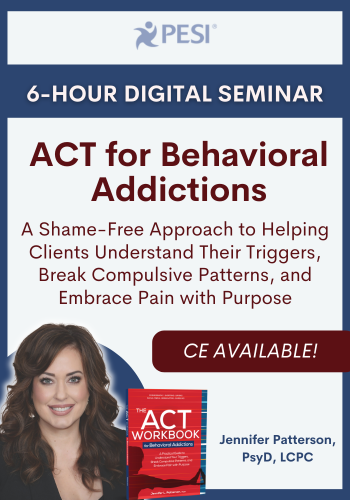
ACT for Behavioral Addictions: A Shame-Free Approach for Helping Clients Understand Their Triggers, Break Compulsive Patterns, and Embrace Pain with Purpose
- Speaker:
- Jennifer L. Patterson, PsyD, LCPC
- Duration:
- 6 Hours 17 Minutes
- Language:
- Presented in EN, subtitles in EN and FR, handouts in EN and FR
- Copyright:
-
May 05, 2026
- Product Code:
- POS150195
- Media Type:
- Digital Seminar

Description
Gain the tools you need to effectively treat clients struggling with behavioral addictions such as gambling, pornography, shopping, and even seemingly benign behaviors like excessive work or exercise, eating, social media doom-scrolling, and general “busyness.”
These behavioral addictions—also called process addictions—are increasingly on the radar as they distract, numb, or protect individuals from pain, keeping them disconnected from meaningful engagement in life.
In this recording, Dr. Jennifer Patterson will explore the hot topic of whether certain behaviors can truly be “addictive” and teach you how to identify when a coping skill has become maladaptive, even when it’s not the presenting issue in treatment.
Through real-world case studies, you’ll learn how to integrate Acceptance and Commitment Therapy (ACT) to break shame cycles, foster psychological flexibility, and guide clients toward actions aligned with their values.
With a focus on practical tools and strategies, this training will empower therapists and clinicians to address compulsive patterns, prevent relapse, and help clients embrace recovery and purpose-driven living.
Transform lives and help clients break free from addictive behaviors, one mindful step at a time.
Credit
Speaker

Jennifer L. Patterson, PsyD, LCPC Related seminars and products
JPI Psychological Solutions
Jennifer Patterson, Psy.D., LCPC, has a mission to offer evidence-based psychotherapy to help others live full and abundant lives. She is the founder of JPI Psychological Solutions in Mokena, Illinois and specializes in treating obsessive compulsive behaviors, anxiety and depression. At JPI she uses ACT and other third-wave models to assist clients with increasing quality of life.
Dr. Patterson is an ACT trainer and has led over 500 ACT workshops across the US and internationally. She has served as vice-president of the Chicago Chapter for the Association for Contextual Behavioral Sciences. Dr. Patterson was a featured psychologist on The Learning Channel (TLC) and former co-author for Psychology Today’s blog “When More Isn’t Enough.” Dr. Patterson received both her master’s and doctoral degrees from the Illinois School of Professional Psychology. She is a formally trained ACT clinician and is very skilled in mindful-based therapies and empirically-supported treatments.
Speaker Disclosures:
Financial: Dr. Jennifer Patterson maintains a private practice and receives royalties as a published author. She receives a speaking honorarium, recording royalties, and a consulting fee from PESI, Inc. She has no relevant financial relationships with ineligible organizations.
Non-financial: Dr. Jennifer Patterson is a member of the Illinois Psychological Association, the American Psychological Association, and the Association for Contextual Behavioral Science.
Additional Info
Program Information
Access for Self-Study (Non-Interactive)Access never expires for this product.
For a more detailed outline that includes times or durations of time, if needed, please contact cepesi@pesi.com.
Questions?
Visit our FAQ page at https://www.pesicanada.ca/faq or contact us at https://www.pesicanada.ca/contact-us.
Objectives
- Identify the impact of behavioral addictions on individuals and society, including health, social, and economic consequences.
- Determine the relevance of the biopsychosocial model to behavioral addictions.
- Utilize screening tools and questionnaires for identifying behavioral addictions.
- Identify the six core processes of the Hexaflex Model (Cognitive Defusion, Acceptance, Contact with the Present Moment, Self-as-Context, Values, Committed Action).
- Choose mindfulness and acceptance strategies to increase awareness and acceptance.
- Determine ACT strategies for prevention and relapse management to maintain recovery.
Outline
Introduction to Behavioral Addictions
- Overview of Behavioral Addictions: Definition, types, and examples (e.g., gambling, internet addiction, shopping addiction).
- Epidemiology and Prevalence: Statistics and demographics.
- Impact on Individuals and Society: Health, social, and economic consequences.
Theories and Models of Behavioral Addictions
- Biopsychosocial Model: Understanding the interplay of biological, psychological, and social factors.
- Disease Model vs. Behavioral Model: Comparing different perspectives.
Assessment and Diagnosis
- Screening Tools and Questionnaires: Commonly used tools for identifying behavioral addictions.
- Diagnostic Criteria: DSM-5 and ICD-11 criteria for behavioral addictions.
- Case Studies: Practical examples and discussion.
Acceptance and Commitment Therapy (ACT) Principles
- Introduction to ACT: Origins, core principles, and goals.
- Psychological Flexibility: Understanding and fostering psychological flexibility.
- Hexaflex Model: Exploration of the six core processes of ACT (Cognitive Defusion, Acceptance, Contact with the Present Moment, Self-as-Context, Values, Committed Action).
Applying ACT to Behavioral Addictions
- Assessment and Case Conceptualization: Tailoring ACT interventions to individual clients.
- Mindfulness and Acceptance Strategies: Techniques for increasing awareness and acceptance.
- Values and Committed Action: Identifying values and promoting actions that align with those values.
Case Studies and Practical Applications
- Case Studies: Applying ACT principles to real-life scenarios of behavioral addictions.
- Prevention and Relapse Management: Using ACT to prevent relapse and maintain recovery.
- Resources and Referrals: Providing support and guidance for ongoing care.
Target Audience
- Social Workers
- Psychologists
- Psychiatrists
- Counsellors
- Case Managers
- Marriage and Family Therapists
- Therapists
- Other Mental Health Professionals
Reviews
Satisfaction Guarantee
Your satisfaction is our goal and our guarantee. Concerns should be addressed to info@pesicanada.com.
Please wait ...