


Abandonment, Neglect and Developmental Trauma, 7/28/2026 9:00:00 AM EDT, Live Webinar More info »
Abandonment, Neglect and Developmental Trauma, 3/6/2026 12:00:00 AM EST, Digital Seminar More info »
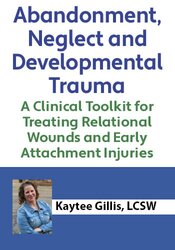
Abandonment, Neglect and Developmental Trauma
A Clinical Toolkit for Treating Relational Wounds and Early Attachment Injuries
- Speaker:
- Kaytee Gillis, LCSW
- Duration:
- Full Day
- Language:
- Presented in EN, subtitles in EN and FR, handouts in EN
- Format:
- Audio and Video
- Product Code:
- LWC150576
- Brochure Code:
- PWZ95245
- Media Type:
- Live Webinar - Also available: Digital Seminar | Live Webinar
Description
- Gently establish safety and trust with clients who push away connection
- Tools to help clients silence their inner critic
- Break cycles of perfectionism, self-sabotage and people pleasing
- Step-by-step interventions you can implement immediately
You see so many clients like this … the ones who desperately seek connection yet push everyone away. People-pleasers trapped in perfectionism. Clients who self-medicate to survive the relentless ache inside.
Their early wounds and childhood traumas have shaped everything for them. Because when parents and caregivers were inconsistent, unavailable, or emotionally neglectful …
… your clients learned that love is conditional, connection is unsafe, and their needs don’t matter.
But treating these clients isn’t easy. They come to therapy with chronic shame, fear of intimacy, and relational patterns that are hard to break.
And every moment of trust can unravel in an instant. Every attempt at vulnerability is met with self-protective withdrawal. And every breakthrough feels fragile and easily undone.
That’s why we teamed up with expert Kaytee Gillis, LCSW to create this essential training.
An experienced clinician whose work has been featured in TIME magazine, BBC world news and Women’s Health magazine – she’s a survivor and best-selling author of Healing from Parental Abandonment and Neglect.
Kaytee has spent her career helping clients heal from the wounds of abandonment trauma. And now, in just one day she’ll guide you through a simple step-by-step framework, full of in-depth instruction, case examples, and demonstrations so you can:
- Identify abandonment trauma and unhealthy attachment patterns
- Recognize, reframe, and replace long-standing trauma responses clients live with
- Help clients undo shame with understanding and self-compassion
- Silence the inner critic that perpetuates cycles of self-blame
- Apply a clinical toolkit to establish safety, security and repair attachment wounds
- And much more!
PLUS you’ll be able to integrate these techniques with DBT, IFS, EMDR, CPT, and other modalities you may already be using in sessions.
Register now!
Credit
Program Information
Planning Committee Disclosure - No relevant relationshipsAll members of the PESI, Inc. planning committee have provided disclosures of financial relationships with ineligible organizations and any relevant non-financial relationships prior to planning content for this activity. None of the committee members had relevant financial relationships with ineligible companies or other potentially biasing relationships to disclose to learners. For speaker disclosures, please see the faculty biography.
NOTE: Each purchase includes CE credit for one individual (participants in full attendance will be able to print the certificate of completion after passing the online post-test (80% passing score) and completing the evaluation). Instructional methods will include PowerPoint, didactic lecture, Q&A, and others.
Continuing Education Information: Credits listed below are for full attendance at the live, interactive webinar only. This webinar is being broadcast live in real-time and must be attended live, in its entirety, in order to earn credit. You will be able to type questions to the speaker. The speaker will see the questions and address them during the presentation as time allows. Please note, your licensing board dictates whether web-based activities are an acceptable form of continuing education, as well as which credit types are acceptable for continuing education hours. Please refer to your licensing board's rules and regulations. If your profession is not listed, please contact your licensing board to determine your continuing education requirements and check for reciprocal approval. For other credit inquiries not specified below, please contact info@pesi.com or 800-844-8260 before the event.
Materials that are included in this course may include interventions and modalities that are beyond the authorized practice of your profession. As a licensed professional, you are responsible for reviewing the scope of practice, including activities that are defined in law as beyond the boundaries of practice in accordance with and in compliance with your profession's standards.
For Planning Committee disclosures, please see the statement above. For speaker disclosures, please see the faculty biography.
Earn up to 6.25 CE hours. Please see below, for more details, as credit amounts vary by jurisdiction and profession.
PESI, Inc. is approved by the Canadian Counselling and Psychotherapy Association to offer continuing education for counsellors and psychotherapists. PESI, Inc. maintains responsibility for the program. This activity is approved for 6.0 credit hours.
PESI, Inc. is approved by the Canadian Psychological Association to offer continuing education for psychologists. PESI, Inc. maintains responsibility for the program. This program is approved for 6.0 continuing education hours. Full credit statement at: www.pesi.com/cpa-statement

PESI, Inc., #1062, is approved as an ACE provider to offer social work continuing education by the Association of Social Work Boards (ASWB) Approved Continuing Education (ACE) program. Regulatory boards are the final authority on courses accepted for continuing education credit. ACE provider approval period: January 27, 2026 - January 27, 2029. Social workers completing this course receive 6.25 Clinical continuing education credits.
Course Level: Intermediate Format: Synchronous distance. Full attendance is required; no partial credits will be offered for partial attendance.
Canadian Social Workers: Canadian provinces may accept activities offered by providers approved by the ASWB ACE program for ongoing professional development.
This activity qualifies for 380 continuing education minutes as required by many national and local licensing boards and professional organizations. Save your activity advertisement and certificate of completion, and contact your own board or organization for specific requirements.

This course has been approved by PESI, Inc., as a NAADAC Approved Education Provider, for educational credits. NAADAC Provider #77553. PESI, Inc. is responsible for all aspects of their programming.
This course offers 6.0 continuing education contact hours in the Counseling Services skill group. Full attendance is required; no partial credit will be awarded for partial attendance.

PESI, Inc. is accredited as a provider of nursing continuing professional development by the American Nurses Credentialing Center’s Commission on Accreditation. Nurses in full attendance will earn 6.25 contact hours. Partial contact hours will be awarded for partial attendance.
Handouts
| File type | File name | Number of pages | |
|---|---|---|---|
| Manual - Abandonment, Neglect and Developmental Trauma (3.4 MB) | 130 Pages | Available after Purchase |
Speaker

Kaytee Gillis, LCSW Related seminars and products
Kaytlyn “Kaytee” Gillis, LCSW, is a licensed clinical social worker and psychotherapist, specializing in work with survivors of family of origin trauma, including childhood abuse, family dysfunction, rejection and abandonment.
She is the author of several books on healing from domestic abuse and family trauma including Healing from Parental Abandonment and Neglect: Move Beyond Insecure Attachment to Build Safety, Connection, and Trust Yourself and Others (New Harbinger, 2025). Kaytee has a popular column on Psychology Today and is a frequent contributor to Psychotherapy Networker whose work has been featured in TIME magazine, BBC World News, Women’s Health Magazine, The Los Angeles Times, and other media outlets.
In addition to her practice and writing, she’s also a PhD candidate at Michigan State University, focusing on intimate partner violence research and provides training nationwide on recognizing patterns of domestic violence and treating family trauma. Find out more about Kaytee at her website: www.kaytlyngillislcsw.com.
Speaker Disclosures:
Financial: Kaytlyn Gillis maintains a private practice and has an employment relationship with Michigan State University. She receives royalties as a published author. Kaytlyn Gillis receives a speaking honorarium from Psychotherapy Networker and PESI, Inc. She has no relevant financial relationships with ineligible organizations.
Non-financial: Kaytlyn Gillis has no relevant non-financial relationships.
Alternate Dates
|
Abandonment, Neglect and Developmental Trauma
Tue, Jul 28, 2026 - 09:00am to 05:00pm EDT - Product Code LWC150576 |
Additional Info
Program Information
Access Period for Live WebcastFor live CE credit, you must watch the live webcast in its entirety at its scheduled time and complete the CE quiz and evaluation within one week. You will have access for 90 days after the program for review.
Webcast Schedule
Please note: There will be a 70-minute lunch and two 15-minute breaks; one in the morning and one in the afternoon. Lunch and break times will be announced by the speaker and at their discretion. A more detailed schedule is available upon request.
Questions?
Visit our FAQ page at https://www.pesicanada.ca/faq or contact us at https://www.pesicanada.ca/contact-us.
Objectives
- Examine the impact of abandonment and parental emotional neglect on the development of trauma and later adult functioning.
- Identify the clinical relevance of childhood trauma’s impact on attachment styles and adult relationships.
- Evaluate the impact of parental abandonment on the development of shame and self-blame in clients.
- Utilize clinical strategies to reduce shame and avoidance by reframing client behaviors as trauma adaptations rather than pathology.
- Choose validation, journaling, and modeling interventions with clients with histories of abandonment or neglect to establish safety, work with critical inner dialogues, and build self-compassion.
- Use a phase-based treatment approach with adult clients in treatment for childhood trauma.
Outline
Abandonment, Attachment and Developmental Trauma 101
- Overview
- Influences in fields of trauma
- What is abandonment trauma?
- Developmental trauma & attachment-related trauma
Symptoms, Effects and Comorbidities
- Intersectionality
- Developmental trauma’s impact on the developing brain and personality
- Symptoms & effects of abandonment trauma
- Comorbidities and somatic symptoms
- Trauma’s effect on health
Impacts on Attachment on Relationships, Parenting and More
- Attachment theory and case examples
- Attachment disruptions and emotional regulation
- Impacts of abandonment trauma on relationships
- Educational impacts
- Parenting impacts
- Psychoeducation to help clients understand their younger selves
Assessment and Trauma Treatment Using a 3 Phase Approach
- Common survival responses: behaviors/outcomes/personality traits
- Trauma-informed assessment principles
- Assess PTSD & C-PTSD (symptoms, impairment, duration)
- Treatment planning: goals, objectives, and progress markers
- When to refer out
- 3 Phase trauma treatment support model:
- Phase 1: Stabilization & safety (rapport, psychoeducation, grounding)
- Phase 2: processing (methods, managing dissociation, journaling)
- Phase 3: integration & reconnection
- Practice activity: grounding/self-regulation
- Risk assessment & differential diagnosis
- Research, risks and limitations
Negative Internal Dialogues, Shame and Emotional Flooding: Journaling, Guided Imagery and Reframing Techniques and Interventions
- Modeling safe adult presence to help attachment trauma
- Monitor and reframe negative internal dialogue
- Journaling, grounding, guided imagery, art
- Support with symptom and relational setbacks
- Clinical strategies for managing shame and emotional flooding
- Research, risks and limitations
Target Audience
- Counselors
- Marriage & Family Therapists
- Social Workers
- Psychologists
- Case Managers
- Addiction Counselors
- Registered Psychotherapists
- Physicians
- Nurse Practitioners
- Other Mental Health Professionals
Reviews
Satisfaction Guarantee
Your satisfaction is our goal and our guarantee. Concerns should be addressed to info@pesicanada.com.
Please wait ...