


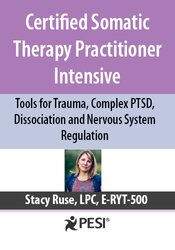
3-Day Certified Somatic Therapy Practitioner Intensive
Tools for Trauma, Complex PTSD, Dissociation and Nervous System Regulation
- Speaker:
- Stacy Ruse, LPC, E-RYT-500
- Duration:
- Three Full Days
- Language:
- Presented in EN, subtitles in EN and FR
- Product Code:
- LWC150992
- Brochure Code:
- PWZ96445
- Media Type:
- Live Webinar - Also available: Digital Seminar

Description
The body keeps the score. Today, it’s an accepted truth in our field.
But far too few of us have gotten the intensive training we need to work with it clinically.
That’s why we created this somatic therapy practitioner certification training. To give you the focused training hours you need to engage the body and nervous system in safe, structured, and clinically effective ways.
You’ll join Stacy Ruse, LPC, E-RYT-500, one of PESI’s most in-demand trainers who’s taught thousands of trauma therapists.
Over 3 intensive training days she’ll give you a powerful somatic-based toolkit and integrative clinical framework that draws from Polyvagal theory, attachment science, IFS inspired parts work, EMDR tools, and transpersonal perspectives …
… so you can confidently treat trauma, chronic dysregulation, dissociation, attachment wounds, and mind-body fragmentation.
And since experiential learning is central to mastering somatic work, Stacy will take you through micro-practices, guided somatic sequences, clinical demos, case examples, and therapist embodiment practices that translate all you learn into embodied, repeatable clinical skills.
PLUS when you finish, you can become a Certified Somatic Therapy Foundations Practitioner through Evergreen Certifications.
And as our gift to you, your certification application, a digital badge and listing on a directory of certified professionals so clients can find you is all yours for FREE.
Register now.
Credit
Speaker

Stacy Ruse, LPC, E-RYT-500 Related seminars and products
Stacy Ruse, LPC, E-RYT-500 is an Evergreen EMDR consultant and clinician, IFS therapist, and founder of Aglow Counseling. She’s a trauma expert who specializes in using IFS Therapy, EMDR, and Somatic therapies to unravel the intricate threads of trauma and guide clients towards empowerment and resilience. Her approach, while deeply rooted in trauma-informed methodologies, is characterized by a transpersonal twist that transcends the boundaries of traditional therapy. Stacy is certified in EMDR as well as a Nationally Certified Counselor (NCC) and Certified Yoga Instructor.
Speaker Disclosures:
Financial: Stacy Ruse is the owner of Aglow Counseling and has an employment relationship with Mindfully. She receives compensation as a consultant and trainer. She receives a speaking honorarium and recording royalties from Psychotherapy Networker and PESI, Inc. Stacy Ruse is a paid consultant for Evergreen Certifications. She has no relevant financial relationships with ineligible organizations.
Non-financial: Stacy Ruse is a member of EMDRIA, the Colorado Association of Psychotherapists, and the Longmont Area Psychotherapy Network.
Additional Info
Program Information
Access Period for Live WebcastYou will have access for 90 days after the program for review. For live CE credit, you must watch the live webcast in its entirety at its scheduled time and complete the CE quiz and evaluation within one week. Please note that this requirement may vary by credit type. Please see detailed credit information for specific requirements for each credit type.
Webcast Schedule
Please note: There will be a 70-minute lunch and two 15-minute breaks; one in the morning and one in the afternoon. Lunch and break times will be announced by the speaker and at their discretion. A more detailed schedule is available upon request.
Questions?
Visit our FAQ page at https://www.pesicanada.ca/faq or contact us at https://www.pesicanada.ca/contact-us.
Objectives
- Use updated neurobiological and polyvagal models to explain how trauma affects the nervous system and body.
- Appraise the evidence and current critiques of polyvagal theory. .
- Examine the evidence base for body and movement-oriented interventions.
- Identify risks and potential limitations of somatic techniques in the treatment of trauma.
- Develop a safe therapeutic environment to prevent re-traumatization of clients.
- Apply five somatic interventions to support nervous system regulation and trauma processing.
- Integrate interoception, titration, and pendulation to guide clients safely through somatic healing.
- Identify somatic markers of dissociation, protector activation, and trauma patterns.
- Select somatic stabilization strategies appropriate to a client’s dissociation profile.
- Use somatic co-regulation practices to support clients with attachment wounds in developing embodied safety.
- Incorporate somatic approaches into IFS-inspired parts work, EMDR, and trauma-informed therapy sessions.
- Identify challenges and limitations in the existing research into the Internal Family Systems framework.
- Utilize breathwork techniques to regulate arousal and promote embodiment.
- Develop treatment plans that sequence somatic interventions appropriately across therapy phases.
- Use somatic micro-interventions to stabilize dissociation, overwhelm, or emotional flooding.
- Evaluate client readiness by assessing nervous system cues and adjusting somatic pacing accordingly.
- Integrate culturally responsive frameworks into somatic treatment planning.
- Apply transpersonal or imaginal somatic methods to deepen embodiment.
Outline
DAY 1 – Foundations of Somatic Trauma Therapy
Module 1: The Neurobiology of Somatic Trauma
- How trauma disrupts adaptive processing (AIP, memory networks, and nervous system dysregulation)
- Sensory, emotional, and cognitive fragmentation
- Body-brain loops: bottom-up & top-down processing
- The roles of the head, heart, and gut in somatic regulation
- The Window of Tolerance (Siegel) and Window of Presence (Chitty): updated models and clinical applications
- Experiential:
- Somatic Micro-Practice #1: Tracking Body Temperature, Texture & Micro-Sensations
- Somatic Micro-Practice #2: Orienting to Safety & Environment
Module 2: Polyvagal Theory in Practice
- The Polyvagal Ladder for clinical use
- Neuroception, cues of safety/danger
- Mapping sympathetic, dorsal, and blended states
- How to work somatically with each state
- Using Polyvagal sequencing to prevent retraumatization
- Experiential:
- Guided Polyvagal Mapping Activity
- “Vagal Glimmers” Embodiment Practice
Module 3: Interoception, Proprioception & Embodied Awareness
- Rebuilding inner connection
- Why interoceptive deficits occur in trauma
- Working with numbness, shutdown, pain, dissociation, and “missing body parts”
- The interoceptive hierarchy: from gross awareness – subtle awareness – emotional awareness
- Experiential:
- Guided Interoceptive Scan
- Hands-on Worksheet: My Body Landscape
Module 4: Somatic Safety, Titration & Pendulation
- Establishing somatic boundaries and consent
- How to titrate safely in complex trauma
- Pendulation as a gentle method of trauma resolution
- Working with overwhelm, collapse, looping, and “too much too fast”
- Experiential:
- Pendulation Practice: Expansion & Contraction
- Container & Anchor Practice
Module 5: The Embodied Therapist
- Embodied countertransference
- Nervous system contagion & co-regulation
- Self-energy through the body
- Ethical boundaries for somatic touch (if used)
- Experiential:
- Sacred Pause Sequence
- Self-to-Therapist Micro-Regulation
DAY 2 – Somatic Interventions for Trauma, Attachment Wounds & Dissociation
Module 6: Working Somatically with Protectors
- How protectors show up somatically (tension, gripping, bracing, numbness, impulses)
- Somatic dialogue with the manager & firefighter parts
- Body-tracking for polarization
- Somatic markers of “not ready”
- Experiential:
- Protector Mapping through Posture
- Somatic Boundary Practice
Module 7: Somatic Approaches for Developmental & Attachment Trauma
- Repairing early relational wounds through the body
- Co-regulation as an intervention
- Somatic reparenting foundations
- Working with collapse, appeasement, and attachment freeze
- Experiential:
- Reparenting Imagery + Somatic Anchor
- Heart-Gut Breath for Co-Regulation
Module 8: Dissociation, Freeze States & Somatic Stabilization
- Somatic signatures of dissociation
- How to safely bring clients “closer to the body” without flooding
- Top-down and bottom-up grounding
- Distinguishing structural dissociation parts through somatic cues
- Experiential:
- Ground-to-Sky Stabilization
- Gentle Re-Entry Practices for Fade-Out Moments
Module 9: Somatic Interweaves & Trauma Resolution
- Using somatic prompts from or within trauma-informed care (EMDR, IFS-inspired parts work, or other modalities)
- Corrective sensorimotor actions
- Incomplete defensive responses (fight/flight/freeze/fawn completion)
- Micro-movements for trauma completion
- Experiential
- Somatic Interweave Practice (pairs or demo)
- Gesture Completion Exercise
Module 10: Clinical Breathwork for Trauma Therapists
- Breathwork neuroscience
- Matching breath to the nervous system state
- Contraindications
- Breathwork library:
- Humming Sigh Breath
- Central Channel Breath
- Sat-Chit-Ananda Kriya
- Oceanic Pacing Breath
- Interoceptive Spiral Breath
- Bilateral Breath
- Flame of Presence Breath
- Root-to-Heart Breath
- Experiential:
- Guided Breath Lab with 3-4 selected practices
DAY 3 – Advanced Integration, Transpersonal Work & Clinical Application
Module 11: Applying Somatic Work in an IFS-inspired Parts Work Framework
- Unblending through sensation
- Somatic Self-energy
- Somatic signatures of protector permission
- Somatic pathways into exile healing
- Body-led unburdening
- Working with legacy burdens in the body
- Experiential:
- Somatic Parts Work Guided Practice: Self-Led Body Dialogue
- Demo: Somatic Unblending Session
Module 12: Integrating Somatic Principles into EMDR Therapy
- When and how to incorporate somatic interweaves
- Somatic assessment before reprocessing
- Working with looping, blocked processing, and protective parts
- State change practices for session prep and closure
- Using bilateral stimulation with somatic anchors
- Experiential:
- Demo
- Practice in structured triads (live version, optional)
- State Change Tool Practice
Module 13: Cultural, Collective & Intergenerational Considerations
- Social nervous system dynamics
- Cultural humility as somatic awareness
- Collective trauma impacts the body
- Working with ancestral patterns and legacy burdens somatically
- Ethics, power, consent, and the somatic experience
- Experiential:
- Collective Body Field Exercise
- Gentle Ancestral Strength Visualization
Module 14: Transpersonal & Energetic Dimensions of Somatic Work
- The body as a site of intuition & wisdom
- Imagery, archetypes, subtle energy, and somatic resonance
- Working with clients’ spiritual or symbolic systems responsibly
- Grounded, evidence-based clinical framing
- Experiential:
- “Inner Sanctuary” Somatic Imagery Practice
- Guided “Central Channel Embodied Presence” Sequence
Module 15: Treatment Planning, Skill Mastery & Integration
- Assessment template for somatic-informed care
- Sequencing somatic interventions across phases of treatment
- Contraindications and precautions
- Case Studies
- Clinical troubleshooting
- Experiential:
- Q&A or case conceptualization/consultation (optional)
- Closing Embodiment Practice: Becoming the Self-Led Somatic Therapist
Target Audience
- Counselors
- Social Workers
- Marriage and Family Therapists
- Psychologists
- Addiction Counselors
- Nurse Practitioners
- Physicians
- Others in caring professions
Reviews
Satisfaction Guarantee
Your satisfaction is our goal and our guarantee. Concerns should be addressed to info@pesicanada.com.
Please wait ...