


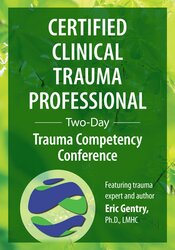
2-Day Certified Clinical Trauma Professional Training
- Speaker:
- J. Eric Gentry, PhD, LMHC, DAAETS, FAAETS, CCTP
- Duration:
- 12 Hours 37 Minutes
- Language:
- Presented in EN, subtitles in EN and FR, handouts in EN and FR
- Copyright:
-
Sep 19, 2024
- Product Code:
- POS059081
- Media Type:
- Digital Seminar

Description
After decades of treating traumatic stress, we have learned that effective treatment can be simple… but it’s not easy.
Studies indicate that there are four key elements to effective trauma treatment. When you accomplish these four key elements in treatment with your clients, you will be able to reduce their symptoms and improve clinical outcomes. Attend this workshop and you will walk away with a step-by-step four-stage framework for navigating essential elements of trauma treatment with your traumatised clients.
The essential elements are common to all evidence-based trauma treatments, you will learn how you can integrate this framework with your current approach or methodology to improve how you treat trauma. Watch J. Eric Gentry, PhD, LMHC, DAAETS, FAAETS, CCTP as he shows you how this trauma competency training can give you tools and techniques for your clinical practice and help improve your trauma treatment outcomes, just as he has for other clinicians around the world.
Best of all, upon completion of this training, you’ll be eligible to become a Certified Clinical Trauma Professional (CCTP) through Evergreen Certifications. Certification lets colleagues, employers, and clients know that you’ve invested the extra time and effort necessary to understand the complexities of trauma counselling. Professional standards apply. Visit ca.evgcert.com/cctp for details.
CERTIFICATION MADE SIMPLE!
- No hidden fees – PESI pays for your application fee (a $99.99 USD value)!
- Simply complete this training and the included post-event evaluation, and your application to be a Certified Clinical Trauma Professional through Evergreen Certifications is complete.*
Attendees will receive documentation of CCTP designation from Evergreen Certifications 4 to 6 weeks following completion.
*Professional standards apply. Visit ca.evgcert.com/cctp for professional requirements.
Credit
Speaker

J. Eric Gentry, PhD, LMHC, DAAETS, FAAETS, CCTP Related seminars and products
Compassion Unlimited
J. Eric Gentry, PhD, LMHC, DAAETS, FAAETS, CCTP, is an internationally recognized leader in the study and treatment of traumatic stress and compassion fatigue. His PhD is from Florida State University where he studied with Professor Charles Figley – a pioneer of these two fields. In 1997, he co-developed the Accelerated Recovery Program (ARP) for compassion fatigue – the world’s only evidence-based treatment protocol for compassion fatigue. In 1998, he introduced the Certified Compassion Fatigue Specialist Training and Compassion Fatigue Prevention & Resiliency Training. These two trainings have demonstrated treatment effectiveness for the symptoms of compassion fatigue, and he published these effects in several journals. He has trained over 100,000 health professionals over the past 20 years.
He has written numerous chapters, papers, and peer-reviewed journal articles in the areas of traumatic stress and compassion fatigue. Dr. Gentry is a Master Traumatologist with over 35 years of clinical experience with trauma, Complex PTSD, personality disorders, and dissociation.
He is the president and CEO of The Forward Facing® Institute and owner of Compassion Unlimited – a private psychotherapy, training, and consulting practice – in Phoenix, AZ.
Speaker Disclosures:
Financial: Dr. J. Eric Gentry maintains a private practice. He is the owner and President of Forward-Facing International, Inc., the Co-director of Community Crisis Support Team, and the CEO of Compassion Unlimited. Dr. Gentry has employment relationships with the AZ Trauma Institute, the Florida Center for Theological Studies, the Argosy University, the Webster University, and the University of South Florida State. He is a consultant and receives compensation. Dr. Gentry is a published author and receives royalties. He receives a speaking honorarium, book royalties, and recording royalties from PESI, Inc. He has no relevant financial relationships with ineligible organizations.
Non-financial: Dr. J. Eric Gentry is a member of the American Counseling Association, the American Academy of Experts in Traumatic Stress, and others. For a complete list, please contact info@pesi.com.
Additional Info
Program Information
Access for Self-Study (Non-Interactive)Access never expires for this product.
For a more detailed outline that includes times or durations of time, if needed, please contact cepesi@pesi.com.
Questions?
Visit our FAQ page at https://www.pesicanada.ca/faq or contact us at https://www.pesicanada.ca/contact-us.
Objectives
- Evaluate the causes of posttraumatic stress and how events turn into posttraumatic symptoms.
- Determine the common elements for treating posttraumatic stress to have better treatment outcomes.
- Identify the clinical application of various theoretical treatment models for traumatic stress and how the common elements are embedded in these models.
- Evaluate traumatic stress from neurobiological, biochemical, psychological, social & spiritual perspectives.
- Integrate evidence-based skills for developing, maintaining, and enhancing your therapeutic relationship for more successful outcomes.
- Utilise ACES as an important tool in cognitive restructuring and evolving identity away from shame towards self-compassion.
- Utilise specific psychoeducation and cognitive restructuring techniques for maximising engagement and participation in early treatment.
- Analyse the efficacy of self-regulation skills as a preliminary treatment intervention and to integrate throughout trauma treatment.
- Integrate CBT techniques to promote the development of stability, self-efficacy, anxiety management, and relational capacities in traumatised clients.
- Utilise empirical markers to know when it is both necessary and safe to transition from the safety/stabilisation phase of treatment into the trauma memory processing phase without guesswork and minimal crises.
- Assess the potential risks and limitations of trauma treatment techniques.
- Integrate skills of neuroception, interoception and acute relaxation to interrupt physiological threat response.
- Develop skills for safety, stabilisation, grounding and containment in trauma treatment.
Outline
The Evolution of Traumatic Stress:
Conceptualise how traumatic stress develops
- Systemic traumatic stress
- Symptom review for DSM-5-TR diagnosis
- Review of effective treatments
- Tri Phasic model
- Most used clinician friendly instruments to assess traumatic stress
Core Competencies of Traumatic Stress Bio-Psycho-Social-Spiritual Factors that Produce Anxiety & Traumatic Stress:
How events can become symptoms
- Precipitating events
- Meaning making
- Physiology of trauma
- Perception
Neurobiology and Biology of Traumatic Stress:
Deeper understanding of the impacts of trauma
- Research of impact of trauma on the brain
- The biochemical, affective, and cognitive impact
- Affective volatility
A Framework of Healing for Survivors of Traumatic Stress:
The simplicity of trauma resolution
- “Active Ingredients” of all trauma treatments
- Cognitive Restructuring & Psychoeducation
- Therapeutic Relationship & Positive Expectancy
- Self-Regulation & Relaxation
- Exposure (in vivo & imaginal)
- Overview of research to support framework
- Strengths and systemic perspective
Effective Treatment Interventions:
Review of the go-to evidence-based approaches
- Cognitive behavioural techniques (PE, CPT & SIT)
- EMDR & bilateral stimulation
- In vivo exposure
- Energy/tapping techniques
- Somatic Experiencing & sensorimotor
- Limitations and weaknesses of evidence-based trauma treatment models
Assessment of Traumatic Stress Disorders:
Connect clients to a diagnosis
- Diagnostic and Statistical Manual of the APA
- DSM-5-TR® changes and limitations
- ACE & developmental trauma
- Diagnosing PTSD with the PCL-5
- ACES (screening & psychoeduction)
- TRS (treatment planning and monitoring)
Evidence-Based Strategies for Trauma Therapy:
Skills to integrate for stabilisation and treatment
- Relaxation/self-regulation
- Grounding
- Containment
- In vivo and imaginal exposure
- Writing/journaling
- Drawing art
- Healing metaphors
- Transitional objects
Empowerment & Resilience Treatment Structure:
Client adaptive and overdaptive coping behaviours
- Psychoeducation/cognitive restructuring
- Trauma adaptation
- Systemic influences
- Emotional & psychological stressors
- Information processing model
- Psychosocial model
- Posttraumatic growth & resilience
Interactive Exercises/Application of Skills:
Live demonstrations to practice skills
- Cognitive behavioural techniques
- In vivo exposure protocols to begin healing immediately
- Thought Field Therapy (TFT)
- Bilateral stimulation
The Role of Traumatic Stress in Other Clinical Disorders:
Considerations for Personality Disorders, Dissociative Identity Disorder & more
- Traumagenesis
- Traumaddiction
- Comorbidity
Target Audience
- Counsellors
- Social Workers
- Psychologists
- Case Managers
- Addiction Counsellors
- Therapists
- Art Therapists
- Marriage & Family Therapists
- Nurses
- Physicians
- Other Mental Health Professionals
Reviews
| 5 |
|
| 4 |
|
| 3 |
|
| 2 |
|
| 1 |
|
Overall: 5
Total Reviews: 22
Satisfaction Guarantee
Your satisfaction is our goal and our guarantee. Concerns should be addressed to info@pesicanada.com.
Please wait ...