


Certification Conference: Alzheimer's, Dementias and Geriatric Mental Health Conditions, 3/13/2025 12:00:00 AM EDT, Digital Seminar More info »
FREE LIVE EVENT! | 2-Day Certification Conference: Alzheimer's, Dementias and Geriatric Mental Health Conditions, 7/30/2026 9:00:00 AM EDT, Online Course More info »
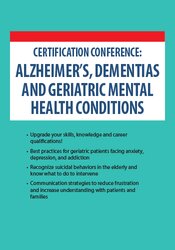
2-Day Certification Conference: Alzheimer's, Dementias and Geriatric Mental Health Conditions
- Speaker:
- Micheal Shafer, PhD
- Duration:
- Two Full Days
- Language:
- Presented in EN, subtitles in EN and FR, handouts in EN and FR
- Format:
- Audio and Video
- Product Code:
- LWC056320
- Brochure Code:
- PWZ95199
- Media Type:
- Live Webinar - Also available: Digital Seminar | Online Course
Description
No matter the discipline, very few providers have received adequate training on safely and effectively meeting the complex mental and behavioral health needs of older adults.
Don’t be caught unprepared!
Whether you’re a social worker, psychologist, counselor, nurse, OT, PT, SLP, or Long-Term Care professional, this training is exactly what you need to ensure proper care for geriatric patients facing Alzheimer’s, other dementias, depression, anxiety, trauma, substance use issues, and suicidal ideation. More than a broad overview, this training will give you specific strategies and interventions tailored to older adults.
Over 2 intensive days of specialized training you’ll receive:
- Cognitive assessment tools and interpretation tips
- Practical solutions to challenging behaviors in dementia patients
- Detailed guidance on recognizing the warning signs of suicidal behavior in older adults
- Adaptive solutions to treat late life depression, anxiety, trauma and drug use
- Tips and tactics for successfully working with families
Sign up today and leave feeling prepared and confident in your ability to overcome the most challenging complexities of working with geriatric patients!
Best of all, upon completion of this live training, you’ll be eligible to become an Evergreen Certified Dementia Care Specialist (ECDCS) through Evergreen Certifications. Certification lets colleagues, employers, and clients know that you’ve invested the extra time and effort necessary to understand the complexities of dementia care counselling. Professional standards apply. Visit www.evergreencertifications.com/ecdcs for details.
CERTIFICATION MADE SIMPLE!
- No hidden fees – PESI pays for your application fee (a $99 value)!
- Simply complete this live event and the post-event evaluation included in this training, and your application to be an Evergreen Certified Dementia Care Specialist through Evergreen Certifications is complete.*
Attendees will receive documentation of ECDCS designation from Evergreen Certifications 4 to 6 weeks following the program.
*Professional standards apply. Visit www.evergreencertifications.com/ecdcs for professional requirements.
Credit
Program Information
Planning Committee Disclosure - No relevant relationshipsAll members of the PESI, Inc. planning committee have provided disclosures of financial relationships with ineligible organizations and any relevant non-financial relationships prior to planning content for this activity. None of the committee members had relevant financial relationships with ineligible companies or other potentially biasing relationships to disclose to learners. For speaker disclosures, please see the faculty biography.
NOTE: Each purchase includes CE credit for one individual (participants in full attendance will be able to print the certificate of completion after passing the online post-test (80% passing score) and completing the evaluation). Instructional methods will include PowerPoint, didactic lecture, Q&A, and others.
Continuing Education Information: Credits listed below are for full attendance at the live, interactive webinar only. This webinar is being broadcast live in real-time and must be attended live, in its entirety, in order to earn credit. You will be able to type questions to the speaker. The speaker will see the questions and address them during the presentation as time allows. Please note, your licensing board dictates whether web-based activities are an acceptable form of continuing education, as well as which credit types are acceptable for continuing education hours. Please refer to your licensing board's rules and regulations. If your profession is not listed, please contact your licensing board to determine your continuing education requirements and check for reciprocal approval. For other credit inquiries not specified below, please contact info@pesi.com or 800-844-8260 before the event.
Materials that are included in this course may include interventions and modalities that are beyond the authorized practice of your profession. As a licensed professional, you are responsible for reviewing the scope of practice, including activities that are defined in law as beyond the boundaries of practice in accordance with and in compliance with your profession's standards.
For Planning Committee disclosures, please see the statement above. For speaker disclosures, please see the faculty biography.
Earn up to 12.5 CE hours. Please see below, for more details, as credit amounts vary by jurisdiction and profession.
PESI, Inc. is approved by the Canadian Counselling and Psychotherapy Association to offer continuing education for counsellors and psychotherapists. PESI, Inc. maintains responsibility for the program. This activity is approved for 12.5 credit hours.
PESI, Inc. is approved by the Canadian Psychological Association to offer continuing education for psychologists. PESI, Inc. maintains responsibility for the program. This program is approved for 12.5 continuing education hours. Full credit statement at: www.pesi.com/cpa-statement

PESI, Inc., #1062, is approved as an ACE provider to offer social work continuing education by the Association of Social Work Boards (ASWB) Approved Continuing Education (ACE) program. Regulatory boards are the final authority on courses accepted for continuing education credit. ACE provider approval period: January 27, 2026 - January 27, 2029. Social workers completing this course receive 12.75 Clinical continuing education credits.
Course Level: Intermediate Format: Synchronous Distance. Full attendance is required; no partial credits will be offered for partial attendance.
Canadian Social Workers: Canadian provinces may accept activities offered by providers approved by the ASWB ACE program for ongoing professional development.
This activity qualifies for 760 continuing education minutes as required by many national and local licensing boards and professional organizations. Save your activity advertisement and certificate of completion, and contact your own board or organization for specific requirements.

PESI, Inc. is accredited as a provider of nursing continuing professional development by the American Nurses Credentialing Center’s Commission on Accreditation. Nurses in full attendance will earn 12.5 contact hours. Partial contact hours will be awarded for partial attendance.
Handouts
| File type | File name | Number of pages | |
|---|---|---|---|
| Manual - 2-Day Certification Conference: Alzheimer’s, Dementias and Geriatric Mental Health Conditions (11.6 MB) | 92 Pages | Available after Purchase | |
| Manual - 2-Day Certification Conference: Alzheimer’s, Dementias and Geriatric Mental Health Conditions - French (11.6 MB) | 92 Pages | Available after Purchase | |
| Image | Slide 118 - French (132.9 KB) | 1 Pages | Available after Purchase |
| Manual - 2-Day Certification Conference: Alzheimer’s, Dementias and Geriatric Mental Health Conditions - Italian (11.6 MB) | 92 Pages | Available after Purchase | |
| Image | Slide 118 - Italian (132.9 KB) | 1 Pages | Available after Purchase |
| Manual - 2-Day Certification Conference: Alzheimer’s, Dementias and Geriatric Mental Health Conditions - German (11.6 MB) | 92 Pages | Available after Purchase | |
| Image | Slide 118 - German (132.9 KB) | 1 Pages | Available after Purchase |
| Manual - 2-Day Certification Conference: Alzheimer’s, Dementias and Geriatric Mental Health Conditions - Spanish (11.6 MB) | 92 Pages | Available after Purchase | |
| Image | Slide 118 - Spanish (132.9 KB) | 1 Pages | Available after Purchase |
Speaker

Micheal Shafer, PhD Related seminars and products
Micheal Shafer Ph.D., is a clinical psychologist who specializes in the diagnosis and treatment of people with dementia. Dr. Shafer holds multiple teaching positions in the Michigan State University School of Medicine in the departments Physical Medicine and Rehabilitation and Radiology.
Dr. Shafer lectures nationally on a variety of clinical and research issues, and has conducted numerous trainings for physicians about medication utilization and mechanisms of actions, particularly for those used to treat Alzheimer's Disease. His primary research/clinical interests include the assessment of neuropsychological disorders (e.g., stroke, traumatic brain injury (TBI), Alzheimer’s) and the study of localized brain functioning. Prior to earning his Ph.D., Dr. Shafer provided hospital-based counseling services and conducted research at the University of Maryland Medical School.
Dr. Shafer earned his M.A. degree in applied psychology from the University of Baltimore and his Ph.D. in clinical psychology with an emphasis on neuropsychology from the University of North Texas.
Speaker Disclosures:
Financial: Dr. Michael Shafer has employment relationships with Michigan State University College of Osteopathic Medicine, University of Michigan Health-Sparrow Lansing Neuropsychology, and PAR Rehab Services. He receives a speaking honorarium and recording royalties from PESI, Inc. He has no relevant financial relationships with ineligible organizations.
Non-financial: Dr. Michael Shafer is a member of the Functional Neurological Disorder Society, the Clinical Neuropsychology, the American Psychological Association, the National Academy of Neuropsychology, and the Michigan Psychological Association. He is a journal reviewer for Neuropsychology, the Journal of Head Trauma, and the Journal of Primary Prevention.
Additional Info
Program Information
Access Period for Live WebcastFor live CE credit, you must watch the live webcast in its entirety at its scheduled time and complete the CE quiz and evaluation within one week. You will have access for 90 days after the program for review.
Webcast Schedule
Please note: Each day there will be a 70-minute lunch and two 15-minute breaks; one in the morning and one in the afternoon. Lunch and break times will be announced by the speaker and at their discretion. A more detailed schedule is available upon request.
Questions?
Visit our FAQ page at https://www.pesicanada.ca/faq or contact us at https://www.pesicanada.ca/contact-us.
Objectives
- Investigate how psychosocial changes, life role transitions, and the unique stressors of late life can impact the mental health of older adults.
- Evaluate how changes in the function of the aging brain and body impact the mental health of older adults.
- Investigate how an aging metabolism’s ability to process pharmacological treatments creates unique safety concerns with geriatric patients.
- Distinguish between types of dementia and connect this information to prognosis.
- Differentiate between the Mini-Mental State Examination and SLUMS as cognitive assessment tools.
- Determine the potential causes of delusions and hallucinations in dementia patients to help reduce the risks of dangerous complications.
- Assess for pain in dementia patients by understanding behavioral cues such as restlessness and agitation.
- Investigate the complexity of suicidal behavior in older adults and use this information to improve your ability to identify the warning signs.
- Evaluate how medical issues can contribute to late-life anxiety and investigate evidenced-based psychological treatments that can help patients reduce symptomology.
- Appraise how psychological trauma can manifest as somatic complaints and determine how this impacts trauma assessment in elderly patients.
- Employ adaptive exercise solutions for physically challenged patients as a late-life depression intervention.
- Investigate why substance abuse in elder patients is often overlooked and use simple assessment instruments to help identify it.
Outline
DAY 1Dementia Differentiation, Diagnosis and Prognosis
- Types of dementia and how to differentiate between them
- Pseudo-dementia explanations
- Mild Neuro-Cognitive Disorder
- Diagnosis, prognosis, and stages
- The latest preventative treatments
- Mini-Mental State Examination
- SLUMS
- Administration and scoring
- Objective and subjective interpretation
Trigger Identification, Problem Solving, and Compassionate Intervention Strategies
- Individualizing care - strengths and limitations
- Pain and pain assessment
- Tactics for verbal and physical combativeness
- Agitation - triggers, pain and care planning
- Delusions and hallucinations -- potential causes and complications
- Wandering – redirection techniques to reduce risks
- Tips for working with sundowners
- Sexual expressiveness and interventions for dignity
- Activities of Daily Living - structure and engagement strategies
Reduce Frustration and Increase Understanding with Dementia Patients
- When traditional communication is replaced by behaviors
- Person centered: Gathering beliefs and values
- Effective tips for communicating with dementia patients
- Find the meaning behind the gesture
- How to avoid arguments
- What questions to ask, and how to ask them
- Meaningful activities that connect
- Family dynamics
- Validation, empathy and active listening
- Caregiver burnout and where to go for help
- End of life issues
- Ethical issues and abuse
How Aging Impacts Mental Health
- The aging brain, body and unique stressors of late life
- Social systems, stigma and life role transitions
- How medical illness impacts mental health
Essential Considerations for Safety and Effectiveness
- The senior metabolism and unique safety concerns
- Common side effect of drugs on seniors
- Interactive effects to be aware of
Assessment and Interventions
- Assessment strategies for late-life depression
- The role of social support
- Working with grief and loss
- Cognitive approaches to focus on today’s problems
- Adaptive exercise solutions for the physically challenged
How to Recognize the Warning Signs and Properly Intervene
- The complexity of suicidal behavior in older adults
- Assessment and screening tools
- Treatment approaches and crisis guidance
- Unique vulnerabilities and diagnostic difficulties
- Assessment instruments
- Motivational Interviewing and relapse prevention strategies
Identification and Treatment Strategies Adapted to Older Adults
- Risk factors, stressors and symptoms
- Loss of social support and fear of being alone
- Medical issues and hypochondria
- Evidence-based psychological treatments
- What the latest research tells us – and what it doesn’t
- Special considerations when assessing seniors for trauma
- Trauma and somatic complaints
- How vitamin and mineral deficiencies impact behavior
- How the volatility of blood sugar can impact behavior
- Strategies for non-compliant eating
Target Audience
- Social Workers
- Psychologists
- Nurses
- Speech-Language Pathologists
- Counselors
- Nursing Home Administrators
- Assisted Living Facility Administrators
- Long Term/Acute Care Professionals
- Case Managers
- Occupational Therapists
- Physical Therapists
Reviews
| 5 |
|
| 4 |
|
| 3 |
|
| 2 |
|
| 1 |
|
Overall: 4.5
Total Reviews: 4
Satisfaction Guarantee
Your satisfaction is our goal and our guarantee. Concerns should be addressed to info@pesicanada.com.
Please wait ...