- Home
- Blogs
- Understanding the 6 Types of Boundaries

The key to healthier relationships is teaching clients how to establish boundaries. Boundaries are expectations and needs in different areas of human experience that help a person feel safe and comfortable in their relationships. Bestselling author and boundaries expert Nedra Glover Tawwab classifies boundaries into 6 distinct categories. They are:
- Intellectual boundaries: Preferences related to how opinions, thoughts, and conversational topics are shared and addressed.
- Emotional boundaries: What, where, and how much a person shares their emotional life and how your own and others’ emotional needs are handled.
- Sexual boundaries: How sexual matters are talked about, when, where, and how sexual material is presented, and consent related to sexual or sexually suggestive words, jokes, images, gestures, or touch.
- Time boundaries: How you relate to your own and others’ time and how time-related needs and preferences are treated.
- Material boundaries: Treatment of possessions and property, preferences and needs regarding possessions and property and how possessions and property are shared.
- Physical boundaries: Physical body, personal space as experienced through your senses and preferences for respect, privacy, closeness, and touch.
Use this free infographic to educate clients on the different types of boundaries they can set, what violations can look like, and how they can protect their peace.

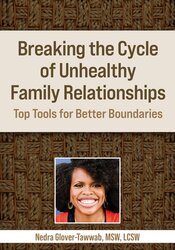
Breaking the Cycle of Unhealthy Family Relationships: Top Tools for Better Boundaries
Learn top tools for better boundaries directly from relationship expert and acclaimed clinician and author, Nedra Glover Tawwab, LCSW.
She’ll give you practical, easy-to-implement interventions that you can use right away to help your clients set better boundaries and transform their interactions with difficulty family members.
Navigating Unhealthy Family Dynamics, Emotionally Immature Parents, and Estrangements
Help clients break the cycle of unhealthy family relationships to create a new legacy of self-respect and healthy boundaries.
You May Also Be Interested In These Related Blog Posts
Straight Talk: Understanding Antidepressant Selection Medications for Depression
By Joseph Wegmann – With medication management playing an increasingly pivotal role in the treatment of mental health disorders, the challenges faced by clinicians are increasing. It's more critical than ever for mental health professionals to understand how to effectively collaborate with practioners prescribing medication. Here's what you need to know...
What to Do When Your Client is Considering Suicide
Paul Brasler, LCSW, CAIMHP discusses how to best support high risk clients, why therapists should avoid creating Contracts For Safety, and tips on creating an effective Safety Plan.
The IFS 6Fs: Simple Steps to Helping Protective Parts Differentiate from the Self
Help your clients gain clarity so they can begin the healing process with this simple 6-step process from Dr. Frank Anderson, lead trainer at the IFS Institute.
How to Know When Your Client Is Ready to Start EMDR Processing
EMDR expert Rotem Brayer shares a 13-step checklist you can use to assess your client's stability and determine if they're ready to start processing.
Straight Talk: Understanding Antidepressant Selection Medications for Depression
By Joseph Wegmann – With medication management playing an increasingly pivotal role in the treatment of mental health disorders, the challenges faced by clinicians are increasing. It's more critical than ever for mental health professionals to understand how to effectively collaborate with practioners prescribing medication. Here's what you need to know...
What to Do When Your Client is Considering Suicide
Paul Brasler, LCSW, CAIMHP discusses how to best support high risk clients, why therapists should avoid creating Contracts For Safety, and tips on creating an effective Safety Plan.
The IFS 6Fs: Simple Steps to Helping Protective Parts Differentiate from the Self
Help your clients gain clarity so they can begin the healing process with this simple 6-step process from Dr. Frank Anderson, lead trainer at the IFS Institute.
How to Know When Your Client Is Ready to Start EMDR Processing
EMDR expert Rotem Brayer shares a 13-step checklist you can use to assess your client's stability and determine if they're ready to start processing.